

Blog
Potty training guide: School readiness everything parents need to know
Blog

by Sara Coffey
Potty training is one of the biggest milestones in early childhood, and it often comes with lots of questions, and often anxieties from parents. When should you start? How long does it take? What if your child isn’t interested?
At Grandir UK nurseries, we support families every step of the way. Our early years teams provide practical toileting/potty training advice, reassurance, and encouragement so both children and families feel confident and supported throughout the journey.
Below, we answer some of the most common questions about toilet training to help guide you through the process.
When should you start potty training?
There is no exact age or “perfect time” to start potty training. Most children show readiness signs somewhere between 18 months and 3 years, but every child develops at their own pace. Signs your child might be ready include staying dry for longer periods, showing interest in the toilet, or telling you when they have a wet or dirty nappy. Research suggests that children who begin toilet training when they show developmental readiness signs often experience a smoother and more successful training process.
If you try to start potty training too early, your child may not be ready to learn the new skill, which can lead to frustration. Waiting until your child shows readiness helps them feel more confident and engaged.
How do you start potty training a child?
To begin, introduce the potty in a calm and positive way. Try letting your child sit on the potty regularly so they become familiar with it. This simple step helps them develop early potty skills without pressure. You can encourage your child to use the potty at routine times, such as after meals or before nap time.
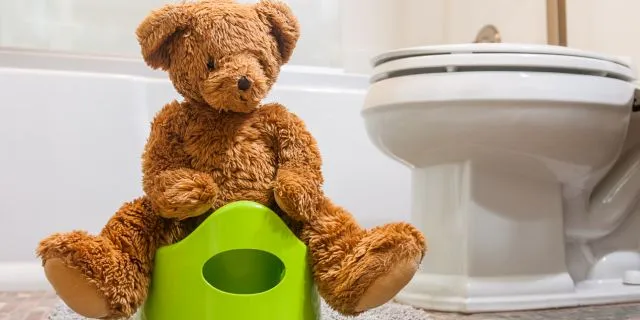
Children love to learn through role play and from the people around them. An engaging way to support children’s interest in toileting is by acting out taking teddies or dolls to the potty/toilet too. Alternatively, parents taking children along with them when they need the toilet – modelling and normalising toileting before children can actively do it themselves.
There are many great resources like toileting and potty training books which support children developing an understanding of toileting both before and during the process.
No matter what method you choose, try to keep routines consistent, as this helps your child understand when to try using the potty or toilet. Some families choose training pants or pull-ups during this stage, while others prefer to move directly from nappies. There is no right or wrong approach; what matters most is what works for your child.
How long does potty training take?
Potty training/toileting is a gradual journey, and there is no set timeline. Some children learn quickly, while others take longer to fully stop using nappies.
Most children become daytime dry before they become night-time dry, and night-time dryness can take much longer to develop. Staying dry at night is linked to bladder development and will happen when your child’s body is ready. Accidents are a normal part of the process, so staying calm and supportive is important. Encouragement helps your child build confidence and keeps the experience positive.
Some families find it helpful to dedicate a few days at home to focus on toilet training, allowing their child to spend time without a nappy and offering regular opportunities to use the potty. Others prefer a more gradual approach. There is no single ‘right’ method; what matters most is following your child’s cues, remaining patient, and keeping the experience positive and pressure-free. Your nursery team will be happy to work with you to ensure a consistent approach between home and nursery.
What should you do when accidents happen?
Accidents are expected when your child is learning a new skill. If your child has an accident, try to stay calm and reassure them. Gently remind your child to try using the potty next time. This helps them learn without fear or stress, making it easier for them to build confidence over time.
What if my child is scared of the potty or toilet?
It is common for children to feel unsure or nervous at the start. You can help by letting them explore the potty or sit on it fully clothed at first. This helps build familiarity and reduces anxiety.
Another common issue is children being happy to use the potty or toilet for wees but feeling worried about doing a poo. Stay calm and avoid putting pressure on them or making them feel rushed. Encourage them to sit on the potty or toilet for a few minutes after meals, when their body is naturally more likely to need a poo, if it doesn’t happen praise them for trying alongside the successes. Make sure their feet are supported with a step stool if using the toilet, as this helps them feel secure and makes it easier to pass a poo. If your child is holding in their poo, appears to be in pain, or the problem continues, speak to your health visitor or GP, as constipation is a common cause and can usually be treated.
Encouragement and routine are key. The more relaxed the experience, the more likely your child is to feel confident using the potty or toilet.
How do nurseries support potty training?
At Grandir UK nurseries, we understand that potty training is a key part of early years development. Our staff play an important role by working closely with parents to support each child’s potty training journey in a way that suits their individual needs.
We provide advice, share updates, and help children build confidence as they learn this new skill. Whether a child is just beginning or already transitioning away from nappies, we ensure they are supported in a calm, consistent, and nurturing environment. Our teams recognise that every child is different, and we adapt our approach to make sure each child feels secure and encouraged.
Key takeaways
Final thoughts on potty training
Potty training is a major milestone, but it doesn’t need to feel overwhelming. With patience, consistency, and the right support, most children will gradually develop the skills they need in their own time.
Whether you’re just beginning or already in the middle of the journey, remember that every child is different, and with reassurance and encouragement, they will get there.
If you want to start the process with your child or are unsure of how to approach it, chat to our nursery staff who will happily talk through the process with your individual child in mind. We are here to support you and your family every step of the way.
You can also find further toilet training support via The Potty Training Guide on the Starting Reception website and content on ERIC.
Tags
Share this article


Related blog/news
Swipe to see our latest articles.